Claire Abendreh - Lesen in Bildern

Autor: admin (Seite 2 von 2)

Reflexions

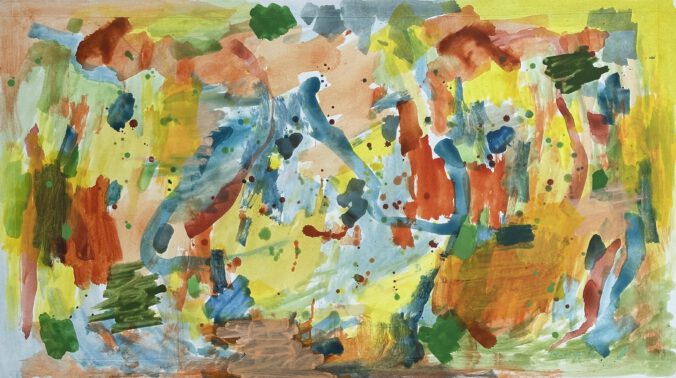
Colin oder die innere Farbe

This contemporary painting is not intended to represent external reality. Rather, it is an invitation to perceive the appearance of Colin (the personification of color)—those fleeting spots, streaks, and afterimages that lie on the eyelid—after being dazzled by looking suddenly into the light and closing your eyes. These colors cannot be named or objectively represented; they are an inner color. The painting invites you to recognize how vision turns inward.

The composition appears as a vibrant field of overlapping traces. Warm ochre, yellow, and red tones meet cool blue and gray layers. Drops, splashes, and hasty gestures seem not to have been placed but to have occurred — just as inner color appearances cannot be controlled. These spots are not signs, but remnants of seeing—echoes of light on the retina.

The title, „Colin or the Inner Color,“ opens up a poetic space. Colin can be interpreted as a name, a character, a bird, or something alive—or as a sound that appears and disappears. The longer you look at the color fields, the more fantastical parrots with winding tail feathers or other animals begin to emerge. They are not really there and yet they are not arbitrary. The image allows for freedom in perception: each viewer sees something different.

This is precisely where the inner core lies. What becomes visible is the color each person perceives differently, simply due to the unique nature of their retinas, pupils, and irises, as well as their vision history. No two people ever see the same thing, even if they can discuss it. From an early age, we agree on names — „blue,“ „yellow,“ „red“ — without ever checking exactly which colors and structures are meant.

This image makes this paradox tangible: communication about color is possible. We see together, but never the same thing.

This is precisely where the freedom and indissoluble mystery of vision lie.

„Colin or the Inner Color“ does not show us what we see; rather, it shows us that seeing is an inner, deeply personal process — a place between light and memory, between the eye and imagination.

What we now see is not just the image.

It is our inner color.

Translated with DeepL.com (free version).
Überall

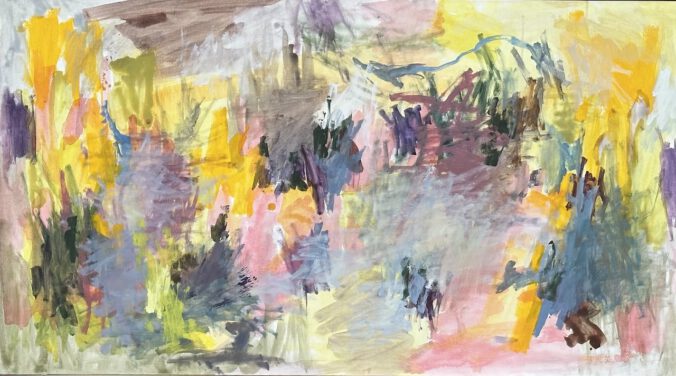
The painting ‚Überall‘ by the artist Bernhard Beyer from 2023 is painted on an HDF plate measuring 45×25″ with eggtempera. The simple frame with shadow joint was made of multiplex especially for the image. The materiality of the eggtempera emphasizes the flatness of the painting.

Bernhard Beyer’s painting goes back to the informal and gives the impression of abstraction at first glance, but can also be discovered as semi-abstract, since the representation is not completely realistic, but with a longer and more closer viewing, a reference to the real world is found or even suddenly sets in.

The painting style is determined by hand-sized color spots distributed on the image surface in different possibilities of color application. The artist applies various techniques such as opaque, stained, dry or wet, open, closed and with a free gesture. The colors of these spots stand on their own and represent their own material and optical quality and quantity. There is no fusion with each other, but the appearance changes due to the superposition of the spots, which can give the impression of a color gradient. At the edges, individual brush strokes seemingly involuntarily flash and a dynamic game begins.

The color spectrum ranges from deep black to other colors to the unpainted white image background without any application of eggtempera. The three basic colors red, blue and yellow dominate. Yellow shines pure, while red and blue occur in pastel-like tones such as rosé and tinted ultramarine up to light azure as well as in mixtures with purple or violet. In between are broken colors such as cream, earth and skin tones. The use of all these colors creates the shocking realization that the picture has gone through 40,000 years of human history and has overcome many challenges. It becomes clear that this way was not easy. This gives the work a natural, rough beauty that fascinates and captivates.

Color stains and overpaints create a strong color tension and a large imaginary space on the surface.

A characteristic feature of the artist is the curved neck-back line, which often appears at the top of the picture, including in this work, but smaller and like a quote from itself. Behind this is a connection between cave painting, such as in Lascaux, and its very own humor. This parietal art shapes the painting style and gives the picture a deep, archaic quality.

This is where the special feature of the picture begins: It reflects the soul of the viewer, as it has not been possible before.

The self-made color of eggtempera with pigments supports this effect, as the shades change in the course of daylight. The bright azure blue of the morning turns into a dark green until the evening, the bright yellow of the day fades into the evening, and so it goes through the day with all colors. This picture experience is of a special kind.

The motives suddenly reproduce. A collection of clearly protruding brush strokes can represent both the contour of a mountain in the distance and a house in the middle image plane and much more. What the eye discovers, be they figures, animals or plants, ultimately also reflects the psyche of the viewer. The image becomes a psychoanalysis for worldly viewers and art lovers who experience self-knowledge through looking here.

The image view becomes an intensive exercise.

The title that cannot be translated into English is ‚Überall‘, which initially means a place that can be anywhere, but also means that all places, this ‚Überall‘, are possible in the picture. In addition, it also includes the universe.

A fascinating thought, an exciting adventure.

In the title, which is deliberately chosen in the German language, there is also the variety of meanings. The title ‚Überall‘ points to the multidimensionality of the work and invites you to an adventure of self-knowledge and worldview.

A successful work.

Bildbeschreibungen von Gegenwartskunst

Hier werden Werke der Malerei beschrieben. Die Texte beruhen auf direkten Begegnungen mit dem – teils abstrakten – Bild, aufmerksam, empathisch und persönlich. Keine endgültigen Interpretationen, sondern vorläufige Beschreibungen.

Der Fokus liegt auf einzelnen Werken, künstlerischen Positionen und Fragen der Wahrnehmung – zwischen Gegenwart und Geschichte.

Paintingdescriptions of contemporary artworks …and art-historical works. Reflections on seeing and thinking about images. Texts based on direct encounters with the image—attentive, empathetic, and entirely personal. These are not definitive interpretations, but open reflections: tentative, descriptive, interpretive.

The focus is on individual works, artistic positions, and questions of perception—between the present and history.

Neuere Beiträge »

© 2026 Bildreflexion

Theme von Anders Norén — Hoch ↑